
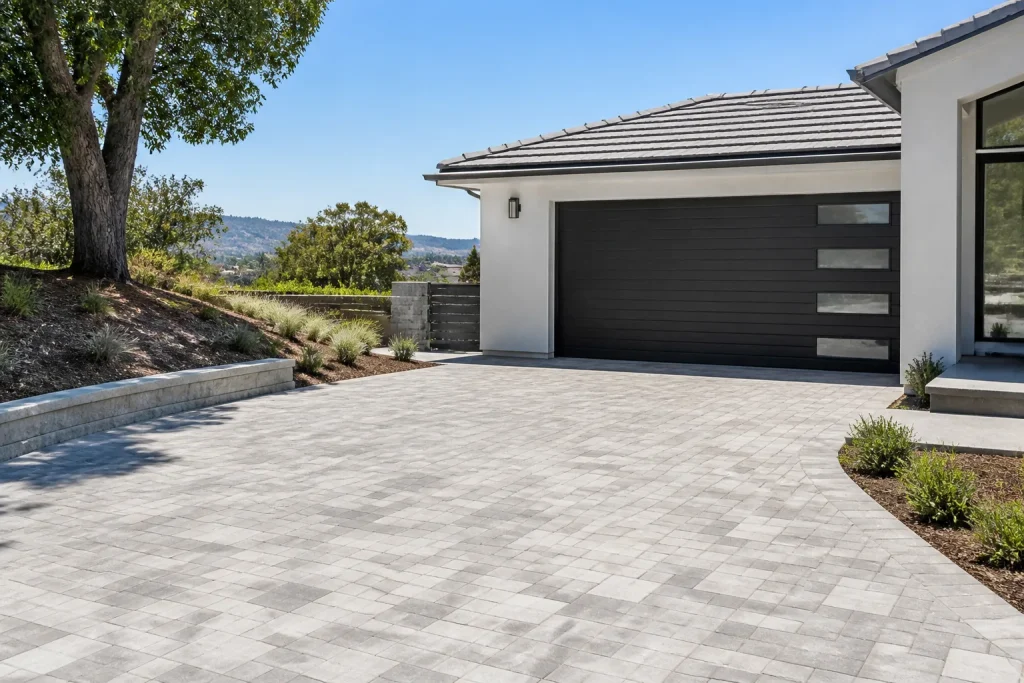
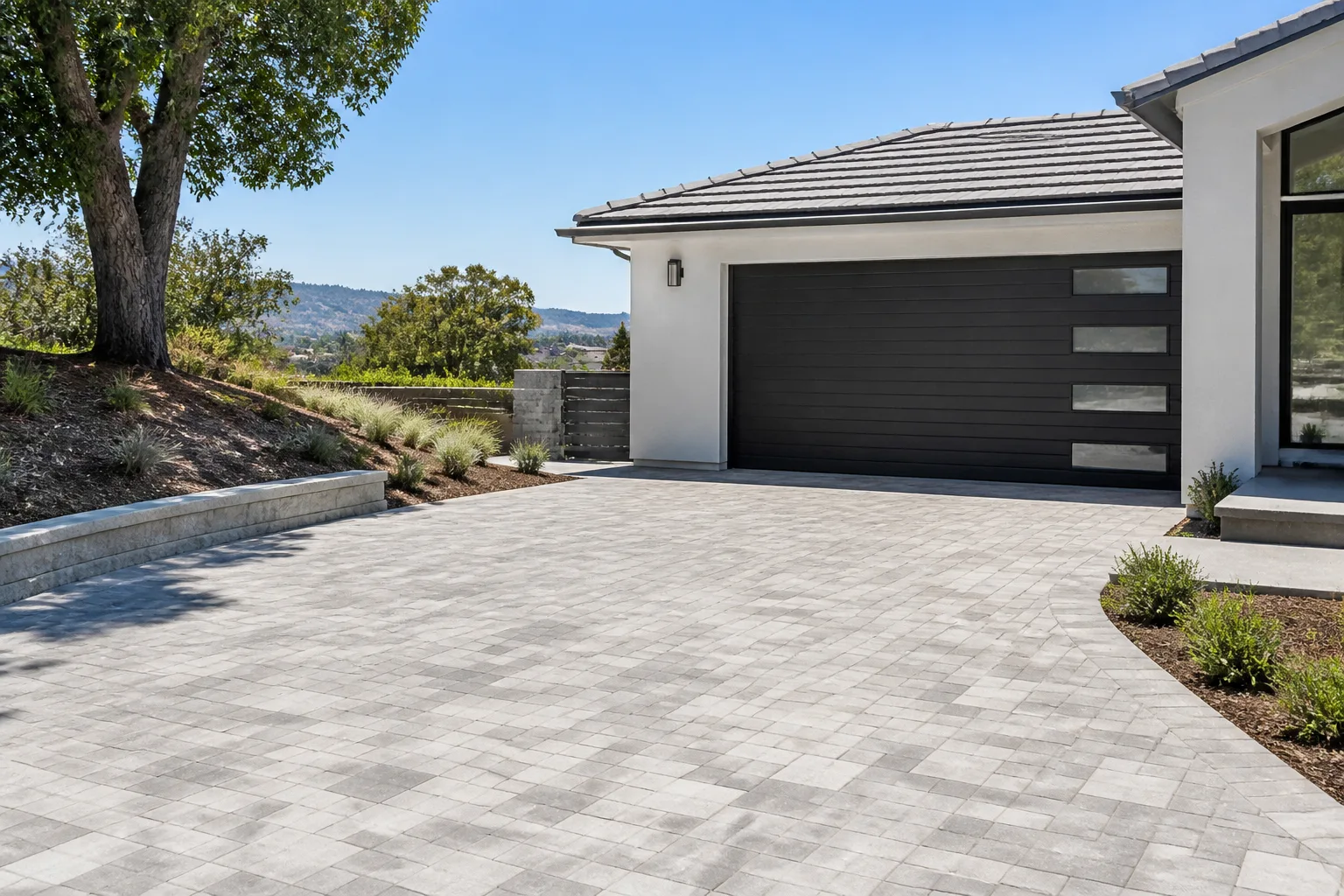
Blanco Driveway & Pavers in Richmond: A Homeowner’s Guide
The paver that looks best in a showroom is rarely the paver that performs best under a 4,500-pound SUV cycling over it 1,500 times a year. Most Richmond homeowners pick their driveway pavers by color, then discover the hard way that walkway-grade material crumbles under vehicle loads. Blanco’s material standards give us a useful starting point for separating the paver that survives a Richmond driveway from the one that just photographs well.
Why Driveway Pavers and Walkway Pavers Aren’t Interchangeable
The single biggest mistake we see in Richmond driveway projects is treating pavers as a finish product instead of a structural one. A walkway carries foot traffic and the occasional wheelbarrow. A driveway carries the same cars and trucks, every day, for decades. Those are different engineering problems, and they need different material specifications.
Concrete pavers are rated by compressive strength in pounds per square inch (PSI). For a residential driveway, we want to see pavers rated at 8,000 PSI or higher. For walkways, patios, and other foot-traffic-only surfaces, 3,000 to 5,000 PSI is generally fine. When a homeowner sources a beautiful low-PSI paver for a driveway because it matched the house color, the failure timeline is predictable: hairline cracks first, then corner spalling, then a paver that looks a decade older than the rest of the drive.
Blanco’s baseline material standards sit in the range that holds up to vehicle loads, but the brand on the box isn’t enough. In Richmond, where many driveways handle two commuter vehicles plus weekend guests, we verify PSI rating, thickness, and freeze-thaw tolerance before we ever talk color. Thickness matters too: 2 3/8 inches minimum for driveways, versus 1 5/8 to 2 inches for walkways.
If you’re sorting through material samples on a kitchen table, here’s the short version: check PSI first, thickness second, brand third, and color last. The order matters.
How Blanco’s Material Consistency Reduces Color Fade and Spalling in Richmond
Richmond has a specific weather pattern that punishes pavers more than homeowners expect: months of dry UV exposure followed by concentrated winter rain. That cycle is a hard test for pigment stability and surface integrity. Cheap pavers fade unevenly and chalk out because the pigment was applied to the surface rather than mixed through the body of the pavers. Blanco’s approach to material consistency reduces that risk by keeping the color uniform through the paver, not just on top of it.
We’ve seen the difference on real jobs. Faded pavers usually fail in patches: a sun-exposed strip along the driveway apron fades six shades lighter than the shaded section near the garage. Pigment-through materials hold their tone across the whole surface. That consistency also shows up in how the pavers weather. Spalling (the flaking and pitting that happens when water freezes inside the paver body, or when a weak surface layer doesn’t bond to the core) is closely tied to material uniformity. A paver made from a single, dense body is much less likely to surface-flake than one made with a separate top finish.
In Richmond’s clay-heavy soils and long wet season, that matters more than it does in drier parts of California. We recommend asking specifically for pigment-through, high-density pavers and reading the manufacturer’s freeze-thaw data, not just the showroom spec.
The Right Joint Sand for a High-Traffic Driveway (and Why Walkway Sand Is Wrong)
Joint sand is the unsung hero of a paver installation, and Richmond driveway projects fail because of it more often than homeowners realize. Standard residential walkway joints use regular joint sand. High-traffic driveways need polymeric joint sand (or a similarly specified high-performance joint material) because it binds the pavers together, resists washout, and stops the joint from opening up under repeated vehicle loading.
Here’s the distinction, clearly:
- Walkways and patios: standard joint sand is acceptable for foot traffic in most cases.
- Driveways: polymeric joint sand (or a specified high-performance equivalent) is the correct choice. It resists washout, stops joint sand loss under tires, and prevents weed growth.
- Climate note for Richmond: our wet winters plus summer dry spells put extra stress on joints. Regular sand washes out faster, and once it’s gone, pavers can shift.
A driveway with the wrong joint sand will show it within two or three winters. When we quote a driveway, the joint sand specification is on the line-item, not assumed.
Sealed vs. Unsealed Pavers: Why Richmond Is Different From Drier California Climates
In much of inland California, sealing pavers is mostly a cosmetic upgrade. In Richmond, it’s more load-bearing than that, because our climate cycle is harsher than the “drier California” assumption most paver buying guides were written for. Richmond’s combination of wet winters and long dry summers means unsealed pavers take on seasonal moisture at the joints, dry out in spring, then take on water again. That cycle is the driver behind surface spalling, joint sand washout, and uneven color aging.
Sealing cuts water penetration at the surface, reduces stain penetration from oil and transmission fluid, and helps hold the joint sand in place. For a vehicle-traffic driveway in Richmond, sealing is the strongest long-term protection. For a shaded walkway or patio, it’s usually optional.
The one firm rule: do not seal a new paver driveway until the installation has fully cured, which is typically a matter of weeks. Sealing too early traps moisture and causes haze, and haze is a hard cost to correct. We recommend sealing within the first year and re-sealing every few years depending on exposure.
Groundwork’s Installation Process for Stable Levels in Richmond’s Expansive Soil
Richmond’s expansive clay soils are the quiet reason many paver driveways settle unevenly. Clay swells when wet and shrinks when dry, and if the base layer doesn’t account for that movement, a perfectly level driveway in summer can be a wavy driveway by spring. The paver material is only half the equation; the base is the other half.
Our installation process layers in a compacted, graded aggregate base sized for the soil conditions we find on each Richmond property, with proper drainage plane and edge restraint. That last piece is the part most cheap quotes skip: edge restraint is what keeps the whole paver field from sliding when a vehicle loads the driveway edge. Compaction is done in lifts, not all at once. We check slope and drainage before any bedding sand goes down.
Our technicians have up to 12 years of experience installing high-traffic hardscapes, and every driveway is backed in writing by our 730-Day Done Right Promise: if it’s not done right, we make it right.
When to Call a Pro
If you’re laying a small walkway or a short path, that’s a reasonable weekend project. If you’re paving a driveway in Richmond with full vehicle traffic, expanded base preparation, joint sand specification, and level stability are things a homeowner can’t reliably get right with a rented plate compactor and a YouTube tutorial. We pulled a paver driveway out in the Point Richmond area last year where the base had been tamped in one pass. Every joint had cracked. That’s not a materials problem; it’s a compaction problem.
If the scope of your Richmond driveway project is larger than you want to take on, our team handles the whole job: material sourcing, base prep, joint sand specification, edge restraint, and finishing.
Related services in Richmond: Driveway & Pavers in Richmond | Fence Installation in Richmond | Home Additions & ADU in Richmond
The Bottom Line
Choose driveway pavers by PSI first (8,000+ for driveways), thickness second, and color last. Use polymeric joint sand for anything a vehicle will roll over. Seal the surface in Richmond’s wet-dry climate, but wait for the installation to fully cure first. And get the base compaction right, because in Richmond’s expansive soil, the base decides whether your driveway stays level.
If you’re in Richmond and need help, Groundwork Construction Co. of Richmond offers free estimates, upfront pricing with no surprises, and 0% financing for 18 months along with $1,000 off projects over $10,000. Our calls are answered by a live person 24/7.
Frequently Asked Questions
What PSI rating do driveway pavers need in Richmond? Driveway pavers should be rated at 8,000 PSI or higher. Walkway pavers can be 3,000 to 5,000 PSI. In Richmond, where driveways see daily vehicle traffic and a wet-dry climate cycle, we won’t specify a paver below 8,000 PSI for a driveway surface. Call (833) 700-4611 for a free estimate.
Does sealing pavers matter more in Richmond than in drier parts of California? Yes. Richmond’s wet winters followed by dry summers create more moisture cycling than inland California, which makes unsealed pavers more prone to spalling and joint sand washout. Sealing within the first year, after full cure, is the right protection. Call (833) 700-4611 and we’ll walk you through the right sealant specification for your driveway.
What joint sand should be used on a paver driveway? Polymeric joint sand (or a specified high-performance equivalent) is the right choice for a driveway. Standard joint sand is fine for patios and walkways. On a vehicle-load surface, standard sand washes out too fast in Richmond’s winter rain. Call (833) 700-4611 to talk through your project.
Will the price change once work starts? No. Groundwork uses no-hassle upfront pricing. The number you see is the number you pay, and joint sand specification, base preparation, and edge restraint are included in the line-item quote, not added later. All work is covered by the 730-Day Done Right Promise. Call (833) 700-4611 for your free estimate.
Written by the team at Groundwork Construction Co. of Richmond.
Need Construction Help?
Call Groundwork Construction Co. of Richmond - licensed & insured, here with fast after-hours help in Richmond.
(833) 700-4611