
Delta Driveway & Pavers in Richmond: A Homeowner’s Guide
Any paver manufacturer can claim “commercial grade” on the box. Fewer than half publish the actual compressive strength data that tells you whether that claim holds up under a loaded delivery truck backing into your driveway on a Tuesday morning. And that’s the gap this guide closes. We’re going to teach you to read a paver spec sheet the way a contractor does – the same discipline Delta applies to faucet tolerances, applied to the surface your vehicles actually pound on. If you’d rather skip the homework and get a straight answer, call (833) 700-4611 for a free estimate.
Why Delta’s Engineering Mindset Is the Right Benchmark for Pavers in Richmond
Delta built its reputation on tolerances you never see – the inside of a cartridge, the seating surface of a valve, the machined fit that stops a drip. The spec sheet is public. You can read the flow rate, the pressure rating, the material composition. That transparency is the point.
Paver manufacturers should be held to the same standard. When you’re shopping for a driveway system in Richmond, you deserve published numbers, not adjectives. Here’s what that looks like in practice:
- Compressive strength – published in psi or MPa. Any paver rated for a residential driveway should clear 8,000 psi. Premium concrete pavers hit 10,000+.
- Water absorption rate – expressed as a percentage. Lower is better. Under 5% is the threshold most engineers use for freeze-thaw durability.
- Freeze-thaw cycle rating – how many cycles the paver survives before surface failure. ASTM C67 and C936 are the test standards to look for.
- Dimensional tolerance – the allowable variance in length and width. Tight tolerances mean straighter joints and a cleaner field.
If a brand won’t publish those four numbers, treat the “commercial grade” claim the way you’d treat a faucet with no flow rating on the box. Skeptically. We evaluate every paver line we install against this checklist before it goes on a Richmond driveway. Kohler and Moen earn their reputations the same way – consistent, repeatable specs, not marketing.
How Do You Read a Paver Spec Sheet? The Three Numbers That Matter
Start with compressive strength, move to water absorption, then check the freeze-thaw rating. That’s the order of importance for a Richmond driveway, and most homeowners read them in exactly the wrong sequence. Here’s the drill-down.
1. Compressive Strength
This is a measure of how much load a paver carries before it crushes. Residential driveways see point loads from a single car tire – maybe 1,500 pounds concentrated on a few square inches. A loaded dump truck delivering landscaping rock can push far higher. Look for a minimum of 8,000 psi, and prefer lines that publish 10,000 psi or better. The number should be on the technical data sheet, not buried in a warranty footnote.
2. Water Absorption Rate
Water is the enemy of every driveway in Richmond. The wet winters we get here push moisture into any paver with open pores. When temperatures drop overnight and that trapped water freezes and expands, the paver spalls – flakes off at the surface. Absorption under 5% is the target. Premium concrete pavers run 3 – 5%. Clay brick pavers typically run 4 – 8%. Natural stone varies wildly; sandstone can exceed 10% and shouldn’t go on a Richmond driveway without careful sealing.
3. Freeze-Thaw Cycle Rating
This one tells you how many freeze-thaw cycles the paver survives before visible surface failure in a lab. Richmond doesn’t get the brutal cycles of the Sierra, but the Bay Area’s winter dips below freezing often enough to matter – especially in the El Sobrante and San Pablo edges of town where cold air settles overnight. Look for a paver rated for 100 cycles minimum. Anything less is a driveway you’ll be patching inside five years.
Why Richmond’s Weather Demands Specific Absorption Tolerances

Richmond sits in a peculiar climate pocket. Wet winters off the Pacific, dry summers with almost no rain from May through October, and a real temperature swing between the two. That cycle stresses a paver field in ways a Phoenix or a Minneapolis driveway will never see.
The problem is trapped moisture. Rain soaks into the paver. The sun comes back in spring and heats the surface to 80 or 90 degrees. Water vapor pushes out from inside. If the paver’s absorption rate is high, that vapor migration eventually weakens the cement matrix. Do that for three or four seasons and you get hairline cracks along the joint edges. By year seven you’re looking at full replacement.
We’ve pulled failed driveways out of Point Richmond and the flats near Marina Bay where the pavers were beautiful on day one and crumbling by year six – almost always a spec sheet problem that was visible on paper before a single paver was laid. The fix is a paver with an absorption rate under 5% and a documented freeze-thaw rating. It costs a little more per square foot up front. It costs a lot less than a rebuild.
Concrete Pavers vs. Clay Brick vs. Natural Stone for Richmond Driveways
Each material has a place. None is right for every job, and the “best” answer depends on how you actually use your driveway.
- Concrete pavers – the strongest choice for most Richmond driveways. Compressive strength hits 10,000+ psi on premium lines, absorption rates sit under 5%, and the color and finish options are wide. Best all-around value.
- Clay brick pavers – excellent freeze-thaw performance when the brick is rated for it (check the spec, not the showroom display). Warmer look, more traditional. Absorption runs higher than concrete but tolerates cycles well if properly installed and sealed.
- Natural stone – beautiful, expensive, and variable. Bluestone and granite perform well. Sandstone and some limestones absorb too much water for a Richmond driveway without aggressive sealing. Stone requires more careful site prep and edge restraint than concrete.
For most driveways in Richmond, a premium concrete paver wins on published performance. If the look you want is brick, buy brick with the numbers to back it up. Don’t let the aesthetic drive the material choice entirely – the driveway is a structural element, not a finish.
The Part Everyone Skips: Edge Restraint Systems
Here’s the failure we see most often in Richmond. The paver field is perfect. The color is right. The layout is clean. Three years later, the edges are spreading out into the yard, the joints are widening, and the whole thing looks like a jigsaw puzzle someone jostled.
The cause is edge restraint – or the lack of it. A paver driveway needs a rigid border on every open side: a concrete curb, an aluminum edge restraint, or a steel L-channel anchored into a compacted base. That edge holds the field in compression. Without it, the pavers migrate outward under every load and every freeze-thaw cycle, and the interlock that makes a paver driveway strong stops working.
A proper edge restraint system costs a few dollars per linear foot. Skipping it saves the installer a couple hundred dollars on a typical Richmond driveway and costs the homeowner a partial rebuild inside four years. If a paver bid doesn’t spell out the edge restraint system, the base depth, and the compaction method, that’s a bid you should ask harder questions about.
What Delta-Tier Material Reliability Looks Like on a Finished Driveway
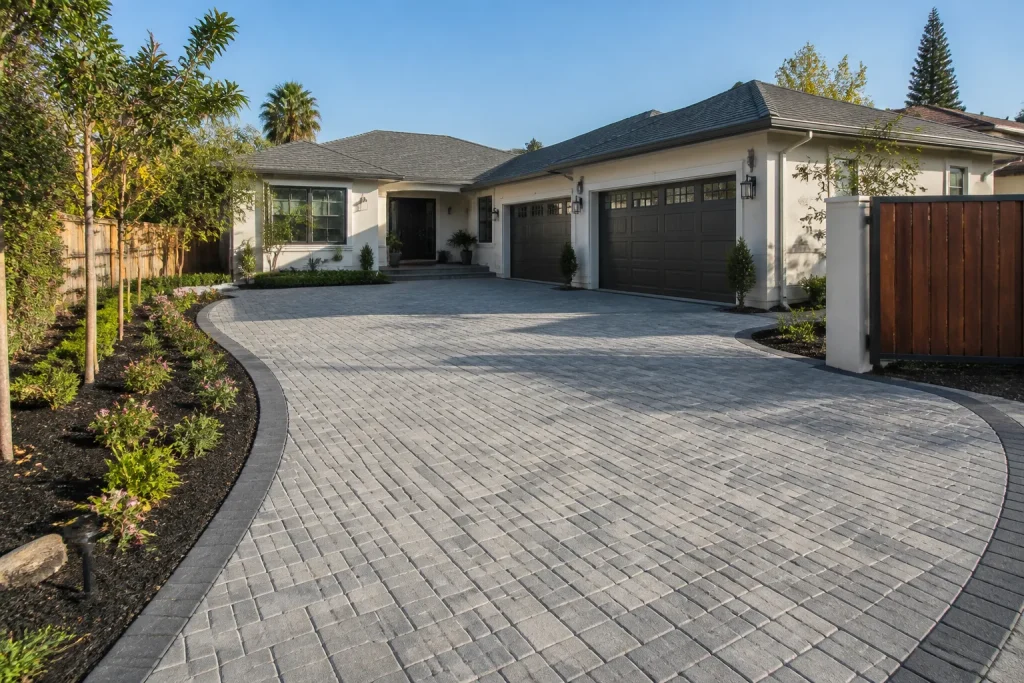
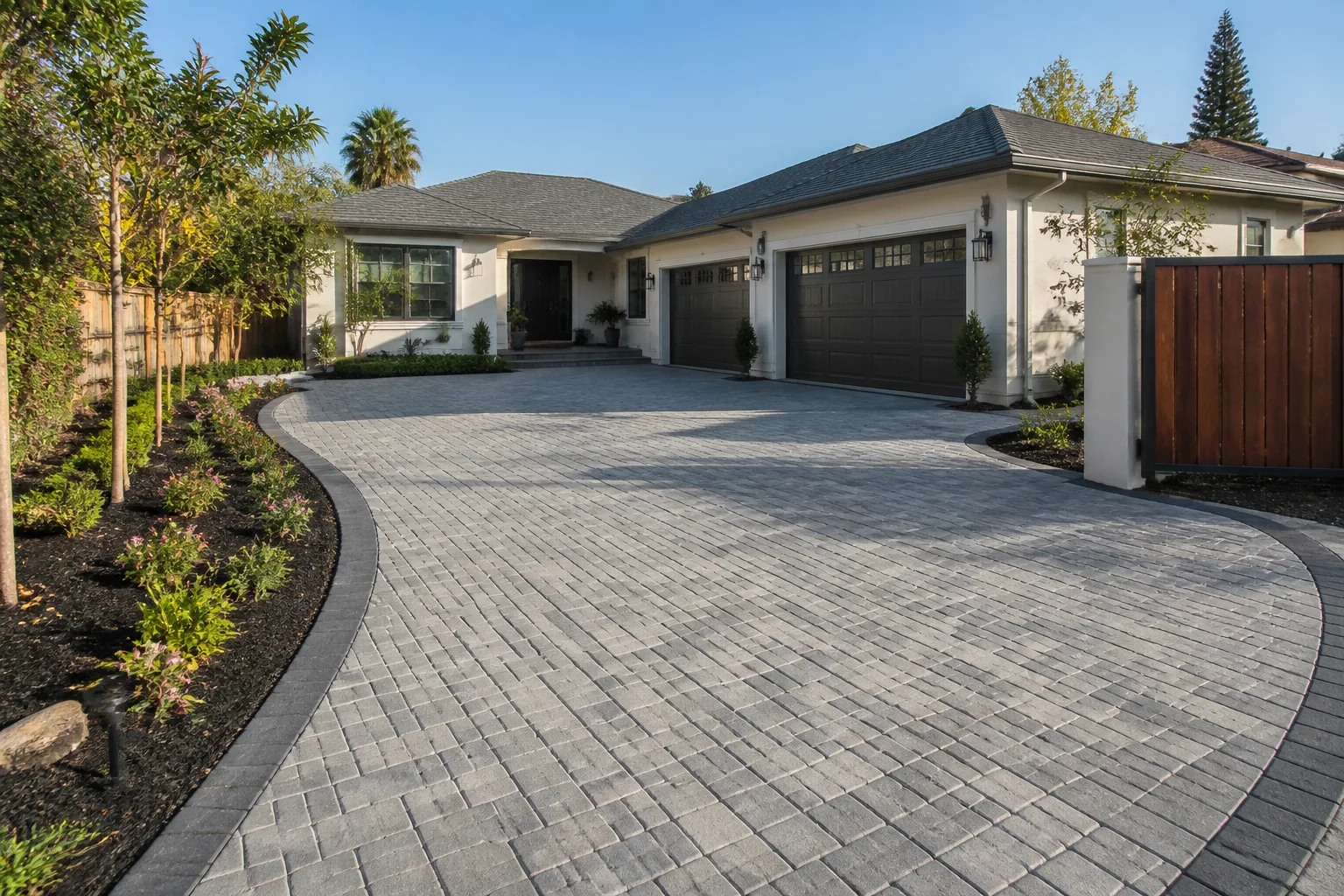
We’ve talked about reading the spec sheet. Now let’s talk about what happens when a driveway is built to those specs. A Richmond driveway installed with premium concrete pavers (10,000+ psi, sub-5% absorption), a properly compacted aggregate base, and a full edge restraint system looks the same on day 2,190 as it did on day one. No spalling. No edge creep. No joint sand washing out every spring. Joints stay tight, the field stays flat, and the only maintenance is a quick sweep and an occasional top-off of polymeric sand every three to four years.
Material reliability in practice means the driveway holds its shape through the wet season and doesn’t require resealing every year. It means the pavers you chose still match after a replacement order four years down the road, because the manufacturer publishes stable color and dimension specs. It means the system behaves the way the spec sheet promised. That’s the standard we hold paver brands to – the same standard you’d expect from a Delta valve or a Kohler fixture.
When to Call a Pro
If you’re reading spec sheets and comparing compression ratings for a 600-square-foot driveway, you’re already ahead of most homeowners. But a few situations warrant a contractor’s eyes:
- Existing driveway failures – spalling, edge creep, or sinkholes mean the base is compromised. A replacement paver in the same spot won’t fix it.
- Sloped approaches – Richmond’s hillside properties near Point Richmond and the El Cerrito border need engineered drainage; a flat-driveway installation method will fail here.
- Utility conflicts – driveways that cross gas, water, or sewer lines need permits and coordination. Get a pro involved before the excavator shows up.
- Tight timelines or delivery access – base compaction requires dry weather and proper sequencing. A pro sequences the job around Richmond’s fog-and-rain pattern.
Related services in Richmond: if your project scope is expanding beyond the driveway, look at our Fence Installation in Richmond work and our Home Additions & ADU in Richmond services. For a deeper dive into the specific system we install, see Driveway & Pavers in Richmond.
The Bottom Line
Richmond homeowners should judge a paver the way they’d judge a Delta faucet: by the published numbers, not the marketing. Compressive strength over 8,000 psi. Water absorption under 5%. A documented freeze-thaw rating. A real edge restraint system. Get those four right and your driveway will outlast the vehicle you’re parking on it.
Our technicians have up to 12 years of experience building driveway systems in this climate, and every install is backed by our 730-Day Done Right Promise – if it’s not done right, we make it right. Pricing is upfront with no surprises, and we offer 0% financing for 18 months along with $1,000 off projects over $10,000. To get started, visit Groundwork Construction Co. of Richmond home or call for a free project estimate and design consult.
If you’re in Richmond and need help, Groundwork Construction Co. of Richmond offers free estimates – call (833) 700-4611. Live person, 24/7. No voicemail, no delays.
Frequently Asked Questions
A paver driveway in Richmond typically runs $14 – $22 per square foot installed, depending on material, base depth, and edge restraint system. A standard two-car driveway of about 500 square feet lands in the $7,000 – $11,000 range. Premium concrete pavers sit at the upper end of that range; basic clay brick often falls in the middle. Call (833) 700-4611 for an exact quote – estimates are free.
There’s no single “best” brand – what matters is the spec sheet. Look for compressive strength over 8,000 psi, water absorption under 5%, and a documented freeze-thaw cycle rating. Brands like Belgard publish those numbers on their technical data sheets. If a brand won’t show you the specs, that’s your answer. Call (833) 700-4611 and we’ll walk you through the brands we trust for Richmond installations.
Sealing is optional for premium concrete pavers with low absorption rates, but it’s worth doing every three to four years in Richmond’s wet-winter climate. It slows surface wear, deepens color, and extends the life of polymeric joint sand. For higher-absorption pavers or natural stone, sealing is effectively mandatory. Ask us at the estimate stage – we’ll tell you the right interval for your specific material.
A typical Richmond driveway takes 3 – 5 working days: one to two days for demo and base prep, one for compaction and edge restraint, and one to two for paver setting and joint sand. Weather is the wildcard – base compaction needs dry conditions. Call (833) 700-4611 to schedule your free estimate and get a firm timeline for your property.
Written by the team at Groundwork Construction Co. of Richmond.
Need Construction Help?
Call Groundwork Construction Co. of Richmond - licensed & insured, here with fast after-hours help in Richmond.
(833) 700-4611