
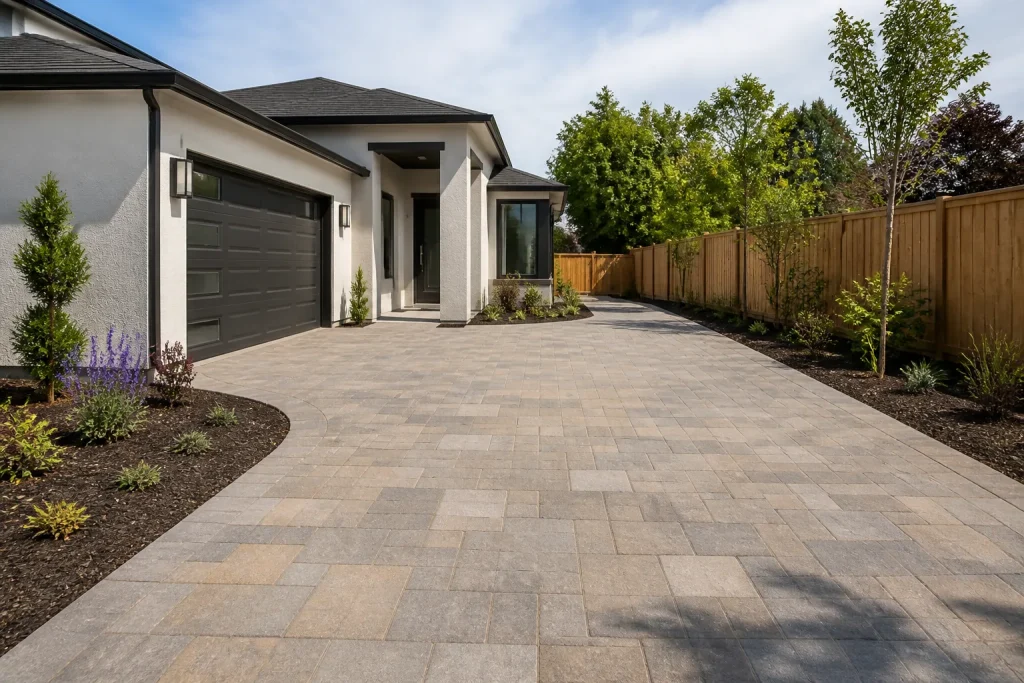
American Standard Driveway & Pavers in Richmond: A Homeowner’s Guide
A premium paver laid on a base that was never properly compacted will start heaving and settling within three years. A mid-grade paver on a correctly engineered base will outlast that first driveway by a decade. The brand on the box matters less than the gravel, the moisture and the compaction underneath it. If you’d rather not gamble on getting the base right yourself, call (833) 700-4611 and we’ll talk you through what your Richmond driveway actually needs.
Why American Standard Pavers Are Worth Considering for a Richmond Driveway
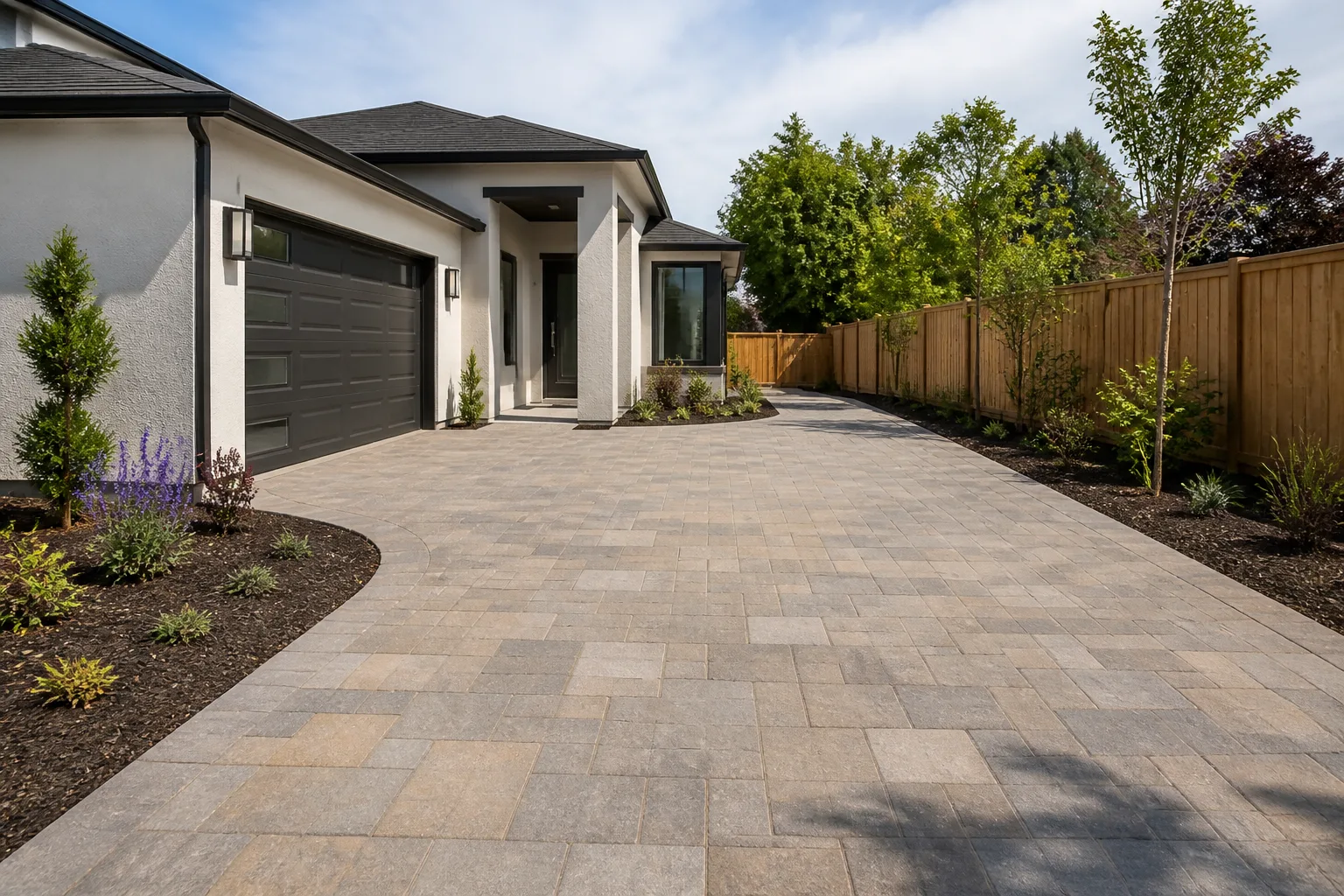
American Standard built its reputation on consistency: the same product, the same dimensions and the same color run today as it was two years ago and likely will be two years from now. That reliability is exactly the benchmark Richmond homeowners should be demanding from their paver contractor’s installation process, not just from the product on the pallet. A paver is only as good as the method used to set it.
Where American Standard earns its keep in Richmond is sourcing. Boutique paver lines come and go, and when a limited-run SKU gets discontinued, matching a repair three or four years later turns into a scavenger hunt across the East Bay. American Standard’s design consistency makes replacement straightforward. If a few units chip after a hard winter, or you add a walkway two summers from now, you’ll find the match far more easily than with a niche brand.
Our guidance for Richmond homeowners is simple: treat the paver brand as the second decision, not the first. Decide on the base specification and the compaction standard before you fall in love with a color. Once those are locked down, American Standard is a strong, dependable choice for the surface. For the complete picture of what we install across the city, see our Driveway & Pavers in Richmond service page.
The Base Layer That Separates a 5-Year Driveway From a 20-Year Driveway
The base is where driveways live or die in Richmond. A properly built base runs deep enough to spread the load of a vehicle, uses the right class of aggregate, and gets compacted in controlled lifts rather than dumped and flattened. Most failed paver driveways we inspect fail from underneath, not from the surface wearing out.
What a professional base specification includes:
- Excavation to depth – the base needs room to be built, which means digging below finished grade, not laying pavers on scraped topsoil.
- Correct aggregate – a graded crushed stone base, not fill dirt, not leftover rubble.
- Compaction in lifts – layers of roughly a few inches, each compacted before the next goes down. Skimping on lifts is the most common shortcut.
- Geotextile separation fabric – this keeps Richmond’s clay-heavy soil from migrating up into the base and turning it into mush.
- Edge restraint – a solid edge keeps the pavers from spreading under load.
Here’s how to verify your contractor is actually building this base rather than just talking about it: ask for the base depth in the written quote, ask for the aggregate specification, and ask how many lifts they compact to. A contractor who can answer all three without hesitation is building a 20-year driveway. One who waves a hand and says “plenty of gravel” is not.
Drainage and Slope: The Calculation Every Richmond Driveway Needs
Richmond gets real rain. Standing water on a driveway is not a cosmetic problem; it’s a slow attack on the base. Water that pools against pavers seeps into the joints, softens the aggregate and, over a couple of seasons, turns a solid driveway into a rocking, uneven mess. Every paver driveway here needs a deliberate slope-to-drain plan, not a rough eyeball.
The professional standard is a consistent cross-slope and a slope that carries water toward the street, a designed drain or a French drain depending on the lot. In flat-lot areas like parts of the Richmond flats, that means engineering the pitch away from the house and toward the street without ponding anywhere in between. On a sloped property, it may mean a channel drain or a step-down design to break the flow. We’ve pulled pavers up in Richmond yards where the installer skipped this step entirely and the base had turned into a shallow bathtub by the second rainy winter.
What to demand when you get quotes:
- The intended finished slope, ideally expressed as a percentage.
- Where water is designed to exit the property.
- Whether a channel drain, French drain or curb detail is included, and at what cost.
- How the contractor will protect any adjacent foundation or fence line from runoff.
A driveway that drains correctly is a driveway that lasts. It’s that simple.
Compaction Testing: The Professional Standard We Use on Every Paver Project
Compaction testing is the step most homeowners never hear about and the step that most separates a serious paver contractor from a weekend crew. Visual inspection is not enough. A contractor can look at the base and say “that looks tight,” but compacted dirt and uncompacted dirt can look nearly identical to the naked eye. Compaction testing verifies the base is actually dense enough to carry the load.
On our paver projects, we compact in controlled lifts and evaluate the base before the sand bed and pavers go down. That’s not a marketing flourish; it’s the difference between a driveway that stays put for two decades and one that starts settling the first hot summer. Because we back the whole installation with the 730-Day Done Right Promise, we’re building bases we’d happily stand behind five years from now.
When you’re comparing Richmond paver contractors, this is one of the sharpest questions you can ask: “Do you compact in lifts, and how do you verify the base density?” An experienced installer will talk about lift depth and testing without flinching. A less experienced crew will change the subject to the paver color.
How to Compare Paver Quotes When the Specs Aren’t Listed

The single biggest reason paver quotes are impossible to compare apples-to-apples is that most of them leave the base specification out entirely. One quote looks lower than another, and the only real difference is what’s buried under the pavers. Before you sign anything, get these in writing:
- Base depth in inches, with lift count if the contractor is willing.
- Aggregate type and class for the base material.
- Geotextile fabric – included or not.
- Edge restraint type – concrete curb, plastic edge, or nothing.
- Finished slope percentage and drainage plan.
- Paver brand and SKU – named, not “premium pavers.”
- Compaction method and whether density is checked.
- Warranty terms – length and what’s actually covered.
Our upfront pricing is one flat number with no surprises, and the written quote spells out the base spec because we want you to be able to compare it against anyone else’s. That’s why our technician experience – up to 12 years per installer – matters here: an experienced hand can read a base and a slope, and that judgment is what keeps water moving and pavers locked in place.
When to Call a Pro for Your Richmond Driveway
There’s a small window of paver work that a skilled and patient homeowner can tackle with rented equipment: a short walkway, maybe a patio on stable ground. A full driveway that meets a garage slab, carries vehicle loads and has to manage Richmond rain is a different job. Excavation, base compaction, slope calculation and drainage are all places where a single misstep resets the clock on a very expensive surface.
If you’re already noticing pavers rocking, joints opening up, water pooling against the garage or the surface settling into dips after a wet winter, that’s a base defense problem. Call us and we’ll diagnose it honestly rather than sell you a resurfacing that won’t fix the cause.
Related services in Richmond: many of the same property-edge considerations apply to fencing and hardscape placement, so if you’re planning a full backyard refresh, look at our Fence Installation in Richmond and our Home Additions & ADU in Richmond pages. You can also meet the whole team at Groundwork Construction Co. of Richmond home.
The Bottom Line
Installation method matters more than the brand label. American Standard pavers give you dependable design consistency and easy sourcing years down the road, which makes them a smart pick for Richmond. But the quality of your driveway will come down to the base depth, the compaction standard, the geotextile separation and the slope-to-drain plan underneath. Get those right, and you’re looking at a surface that lasts. Skip them, and no brand saves the driveway.
If you’re in Richmond and need help, Groundwork Construction Co. of Richmond offers free estimates – call (833) 700-4611. Our quotes spell out the base spec, the compaction method and the drainage plan in writing, backed by the 730-Day Done Right Promise, and financing options include 0% for 18 months plus $1,000 off projects over $10,000.
Frequently Asked Questions
American Standard pavers sit in a mid to premium range, but the brand itself usually isn’t the biggest line item on a Richmond driveway – the base and drainage work is. Expect the finished cost to depend far more on excavation depth, base material and compaction method than on which paver SKU you choose. Get a written, itemized quote so you can see where the money actually goes. Call (833) 700-4611 for an exact figure on your property – estimates are free.
A driveway that carries vehicles needs a deeper base than a patio or walkway, typically several inches of compacted aggregate laid in lifts. The exact depth depends on your soil and load, so a professional should specify it in writing rather than give a blanket number. What matters most is that the base is thick enough and compacted properly – not just dumped and smoothed. Call (833) 700-4611 and we’ll spec it for your Richmond lot.
Winter settling is almost always a drainage or compaction problem, not a paver problem. When water ponds against pavers or the slope is wrong, that water softens the base and the surface starts to move. We see this regularly on Richmond driveways where the original install skipped a proper slope-to-drain calculation. Call (833) 700-4611 and we’ll diagnose the cause before recommending a fix.
Yes – and read the fine print, because warranty length alone doesn’t tell you what’s actually covered. Look for a contractor whose warranty covers workmanship on the base, not just the pavers, and who puts that commitment in writing. Our own projects are backed by the 730-Day Done Right Promise: if it’s not done right, we make it right. Call (833) 700-4611 for a free estimate and a written scope.
Written by the team at Groundwork Construction Co. of Richmond.
Need Construction Help?
Call Groundwork Construction Co. of Richmond - licensed & insured, here with fast after-hours help in Richmond.
(833) 700-4611