
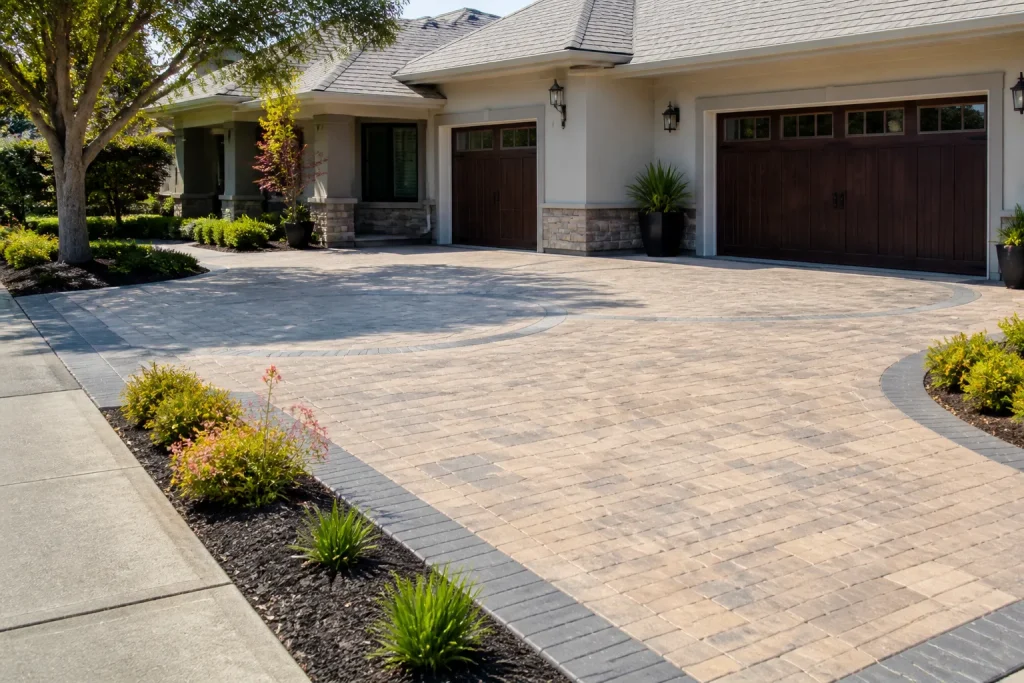
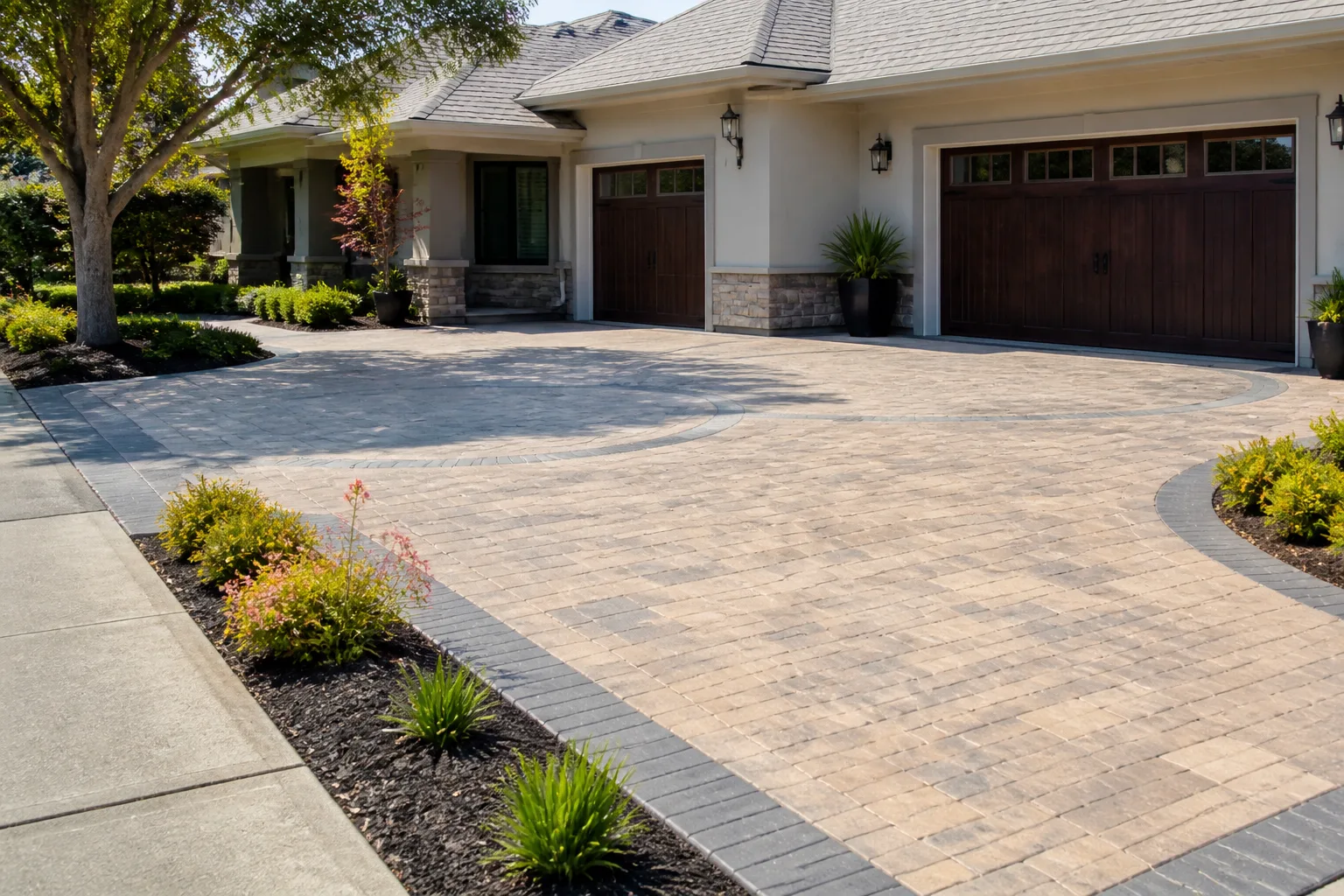
Moen Driveway & Pavers in Richmond: A Homeowner’s Guide
Richmond’s Bay Area clay can swell up to 30% when it soaks in winter rain, and most driveway failures start underground, not at the surface where you finally notice them. Moen’s material engineering, built around durability and tight, consistent tolerances, makes their paver-compatible drainage and edging products a smarter infrastructure choice for that soil than most homeowners realize. This guide treats your driveway as a system, not just a surface. If you’d rather not sort through drainage specs and base depths on your own, call (833) 700-4611 and we’ll walk you through it.
Why Richmond’s Clay Soil Changes How You Should Think About Pavers

The ground under Richmond doesn’t sit still. The clay-heavy soils around the flats and the graded lots up toward the hills take on water in the wet season, expand, and then shrink back as things dry out. Driveways that look perfectly flat in July can heave and settle by February. That movement is what cracks pavers, opens joints, and pushes water toward your garage slab.
Most failed driveways we see in Richmond didn’t fail because the pavers were cheap. They failed because the base wasn’t built to move with the soil. A paver is the visible layer of a stack that runs a foot or more deep, and the clay below is the part doing the moving. When a driveway near you has a low spot that holds water every winter, that’s usually not the paver’s fault. It’s the sub-base losing the fight with expansion.
What Moen brings to this is a different approach to how the surface drains and edges. Moen’s paver-compatible drainage channels and edging are engineered to consistent tolerances so the joints line up and the channel sits at the right grade the first time. In clay country, that consistency matters more than the color palette. If water can’t leave the surface predictably, no paver on earth will stay flat.
How Moen’s Drainage Channels Work With Paver Systems
Moen’s drainage channel products are designed to integrate with a paver system so surface water gets routed away instead of pooling at the low corner of your slab. Here’s what that looks like when it’s done right in Richmond:
- Channel placement at grade. The channel sits flush with the paver surface and slopes toward a discharge point, so winter rain sheet-flows into it rather than sitting on top.
- Consistent tolerances at the joints. Moen builds these products to tight specs so the channel and pavers meet cleanly. That precision matters where the soil moves, because a sloppy joint opens up fast.
- Edging that holds the field. Moen-compatible edging keeps the paver field from spreading under load and lateral soil pressure.
- Discharge that actually drains. The channel is only as good as where the water ends up. On Richmond lots that slope toward a neighbor or the street, that discharge point gets planned, not improvised.
One thing we stress: a drainage channel won’t save a driveway with a bad base. It manages surface water. It doesn’t fix a sub-base that’s already heaving. The two work together or not at all.
The Base Compaction Depth Most Richmond Contractors Skip

This is where the real money and the real failures live. A load-bearing paver driveway needs a compacted aggregate base built in lifts, each lift compacted before the next goes down, at a depth matched to the load and the soil. In Richmond’s expansive clay, we build deeper and compact in thinner lifts than you’d use on stable, sandy ground. Skip that, and the driveway telegraphs every bit of soil movement straight up through the pavers.
What to ask any contractor before Moen-compatible products go down:
- How deep are you excavating, and what’s the compacted base depth in inches?
- How many lifts, and what compaction method are you using between them?
- Are you installing a geotextile separation layer over the clay, and why or why not?
- How are you sloping the base for drainage before the pavers go on top?
- What’s your edge restraint, and how does it tie into the drainage channel?
If a bidder can’t answer those five questions on the spot, that’s your answer. We’ve had homeowners tell us a previous crew quoted a “two-inch base, all in one pour” over the same clay. That driveway didn’t make it through a wet season. The number on the quote wasn’t the problem. The base was.
Decorative Pavers vs. Load-Bearing Pavers: Specs Over Looks
A paver rated for a patio is not the same as one rated for vehicles, and the difference shows up in the product spec, not the showroom. In Richmond’s climate, where clay movement and wet-season loading both work on the surface, you want pavers specified for vehicular load with a consistent thickness and a tight dimensional tolerance so the joints stay closed as the ground shifts.
Moen’s approach to material engineering is the reason we recommend their drainage and edging products as part of the system: durability and consistent tolerances are the design center, and that’s exactly what a driveway over moving clay needs. It’s the same reasoning we apply when we steer a client toward Cambria or Caesarstone on a kitchen counter, or Kohler fixtures in a bath. Spec first, look second. A paver that meets the load spec and the drainage spec will still look good in ten winters. A pretty paver that doesn’t will be a memory.
The aesthetic part, the color, the pattern, the border course, that comes after the spec is locked. Choosing pattern before you’ve chosen load rating is like picking cabinet color before you’ve checked the countertop material.
When to Call a Pro (And How the 730-Day Done Right Promise Applies)

A drainage-integrated driveway is not a weekend project, and the reason is buried in everything above: base prep, compaction, grading, and channel integration all have to be right before a single paver goes down. Get the drainage wrong over Richmond clay and you’ll be re-doing the job inside three years. Get it right and the driveway should outlive your mortgage.
Here’s where our 730-Day Done Right Promise earns its keep on a job like this. If a drainage-integrated system heaves, ponds, or fails at a joint within two years of install, we come back and we make it right. That’s the whole point of putting it in writing. We also build every driveway with upfront pricing, so the number on your quote is the number you pay, and we pull the permits the work requires. Calls get answered by a live person, day or night, so if something goes sideways in the middle of a storm, you’re not leaving a voicemail.
The work itself is done by background-checked, uniformed technicians. Our technicians have up to 12 years of experience, and the same crew that preps the base runs the drainage and paver install from foundation to finish line. If you’d rather hand the whole thing to one contractor than coordinate three, we’ll quote it. Estimates are free.
The Bottom Line
Moen driveway pavers in Richmond make sense when you treat the driveway as a system: Moen’s drainage channels and edging, specified to tight tolerances, handle the surface water your clay soil throws at it, and a deep, properly compacted base built in lifts handles the movement below. Get those two parts right and the pavers do their job. Skip either one and you’re patching in a couple of winters. Spec the paver for vehicular load before you pick a color, ask your contractor the five base questions, and make sure the drainage channel has somewhere real to discharge. If you’re in Richmond and need help, Groundwork Construction Co. of Richmond offers free estimates and stands behind the work with the 730-Day Done Right Promise. Call (833) 700-4611.
Related services in Richmond: If the driveway is one piece of a larger plan, take a look at Driveway & Pavers in Richmond, and if you’re reworking the yard perimeter at the same time, our Fence Installation in Richmond page covers how to sequence both jobs. Planning something bigger down the road? See Home Additions & ADU in Richmond. For everything we do, start at the Groundwork Construction Co. of Richmond home page.
Frequently Asked Questions
Most paver driveways in Richmond land somewhere in the range of $12 to $25 per square foot installed, with the higher end reflecting deeper base excavation and drainage integration. Drainage channels and edging are typically a line item on top of that. The cost driver isn’t the paver, it’s the base and drainage work underneath, which is where Richmond’s clay soil demands more than a generic install. Call (833) 700-4611 for an exact quote, the estimate is free.
Moen’s paver-compatible drainage and edging products are engineered to integrate with standard paver systems, but the field pavers themselves still need to meet the load spec for a driveway. The channel and edging are built for consistency, so the integration is clean, but it doesn’t replace proper paver selection. We’ll spec both together so they work as one system.
On Richmond’s expansive clay, we build deeper than you’d see on stable ground, and we compact in multiple thin lifts rather than one thick pour. The exact depth depends on your soil and the load, but the important part is that it’s matched to your site rather than pulled off a generic chart. That’s a question worth asking any contractor before you sign.
No. Our pricing is upfront, and the number on your quote is the number you pay. We don’t open the quote back up mid-job to cover surprises, which is one of the reasons we do the base and drainage assessment before we put a figure in front of you. Call (833) 700-4611 to schedule a free estimate, and we’ll quote it in writing.
Written by the team at Groundwork Construction Co. of Richmond.
Need Construction Help?
Call Groundwork Construction Co. of Richmond - licensed & insured, here with fast after-hours help in Richmond.
(833) 700-4611