
Toto Driveway & Pavers in Richmond: A Homeowner’s Guide
Most homeowners spec their driveway pavers for how the driveway looks on day one. The ones who don’t regret it spec for what it looks like in year seven, after roughly 42 inches of cumulative rainfall has worked its way into every joint. That single shift in thinking is the difference between a driveway that still sits flat and level and one that’s rutted, settled, and rocking under the tires. This guide is about applying the “over-spec for longevity” philosophy to the pavers under your car.
What Does “Over-Speccing” Pavers Actually Mean?
Over-speccing means choosing a paver whose compressive strength and water absorption numbers sit comfortably above the minimum your driveway technically requires. The standard residential paver carries an ASTM C902 or C936 rating, and the low end of the market lives right at that floor. Over-speccing pushes you toward a denser, tighter clay or concrete body with a compressive strength closer to 8,000 psi and water absorption under 5%, rather than the 6% to 8% you’ll find in bargain-bin pavers. That gap matters because water is the enemy of a driveway, not traffic. A paver that soaks up less water expands and contracts less through the wet season, which means the joint sand stays put and the base doesn’t get pumped full of moisture every time it rains. In Richmond, where the marine layer keeps ground moisture high well into spring, that difference shows up fast.
Why Richmond’s Rainfall Should Drive Your Water Absorption Spec
Richmond averages around 25 inches of rain a year, and most of it lands between November and March in a handful of heavy storms. Add the morning fog that rolls off the bay and the ground stays damp for weeks longer than it does ten miles inland. That’s your number: spec for water absorption of 5% or lower, and don’t let anyone talk you into standard 6% to 8% pavers because “they’re fine for a driveway.” They’re fine in a dry market. Here, over a decade, that extra absorption translates into efflorescence, moss creeping into the joints from the Point Richmond side, and a base that never quite dries out. We’ve pulled pavers out of driveways near the marina that looked perfect on top and were sponge-wet six inches down. The paver wasn’t the only problem, but a tighter unit would have bought that base years more life.
The Long-Term Cost Argument: Price Per Year, Not Price Per Square Foot
Here’s where the math flips the conversation. A budget paver might run $4 to $6 per square foot installed, while a premium over-specced unit runs $8 to $12. On a 500-square-foot driveway, that’s a $2,000 to $3,000 spread you feel today. Now divide it out over lifespan. The budget driveway typically needs re-sanding and joint repair within five years and a full reset or replacement by year twelve to fifteen. The over-specced driveway, when it’s installed on a proper base, holds its joints and elevation for 25 years or more. Run the numbers and the premium paver often costs less per year of service, before you count the repair calls you never make. Richmond homeowners planning to stay put come out ahead; even those planning to sell benefit, because a buyer’s inspector notices a settled driveway.
- Budget paver: ~$5/sq ft installed, 12 to 15 year realistic life, re-sanding around year five. Roughly $0.35 to $0.40 per year per square foot.
- Over-specced paver: ~$10/sq ft installed, 25+ year life, minimal joint work. Roughly $0.40 per year per square foot, with far fewer headaches.
- What flips it: add up two re-sanding jobs and one partial reset on the budget side and the premium driveway wins outright.
Pattern and Joint Width: Structural Choices Disguised as Aesthetics
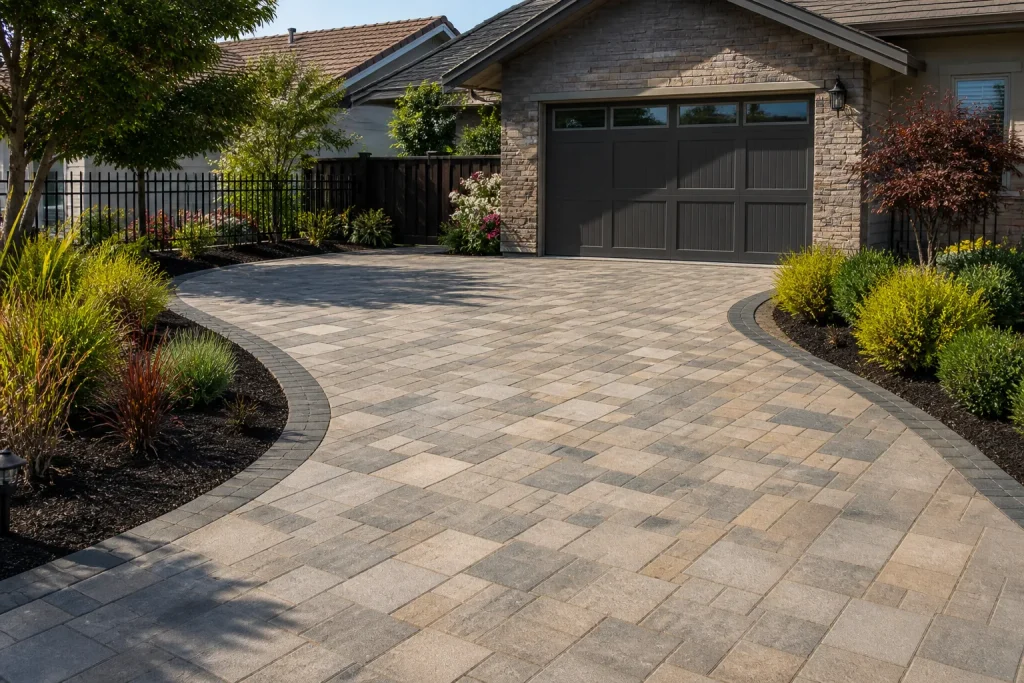
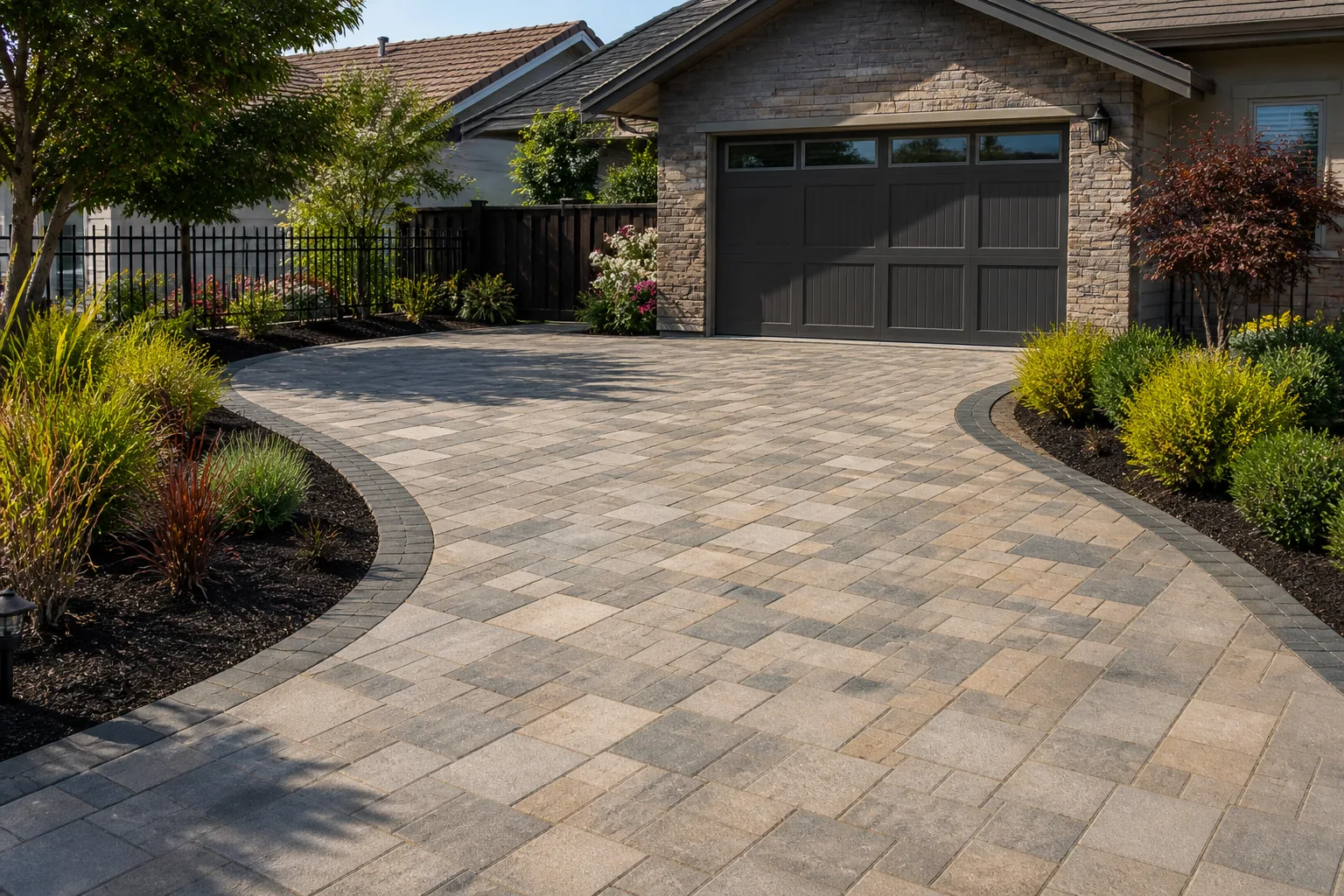
Pattern isn’t just a design decision, it’s a load-path decision. Herringbone at 45 degrees spreads vehicle weight across more units and interlocks tighter than a running bond, which is why it holds up better on driveways that see two cars and a work truck. Joint width matters just as much. A 1/8-inch joint packs tight with polymeric sand and locks the field together; a wide, sloppy 1/2-inch joint becomes a gravel trap that lets water straight into the base. For Richmond driveways handling daily vehicle stress on clay-heavy soil, we specify tighter joints with a stabilized polymeric sand rather than the loose kiln-dried sand that washes out by the second winter. If you’re comparing pavers and the contractor won’t talk joint width, that’s a tell. For the full breakdown of materials and installation on your property, see our page on Driveway & Pavers in Richmond.
How We Make Sure the Spec Sheet Matches What Shows Up
A spec sheet is only as good as the pallet on your driveway. Our sourcing process starts with the actual test data for the specific paver line, not the marketing brochure’s best-case number, and we confirm the batch and manufacturer before it ships. When we’re weighing suppliers, we hold them to the same standard we apply to our window and door lines from partners like CGI and ES Windows: the product has to match its published performance, every time. On the job, we check absorption and dimensional tolerance on arrival and reject units that don’t measure up. That’s how “over-spec” stays honest instead of becoming a line on a bid. It’s also why every driveway we install carries our 730-Day Done Right Promise: if the work isn’t right, we make it right.
When to Call a Pro (and When You Can Wait)
Laying a small paver path is a weekend project. Rebuilding a vehicle-load driveway on Richmond’s clay soil is not, because the base is where driveways fail, not the pavers. If you’re seeing ruts, rocking units, joints that blow out every spring, or water pooling against the garage, that’s a base and drainage problem a fresh layer of sand won’t fix. Our technicians, who bring up to 12 years of experience to each job, can tell the difference in a walkthrough. If you’d rather not gamble on the base, call (833) 700-4611 and we’ll take a look.
Related services in Richmond: the driveway often shares a property line with the fence, so we also handle Fence Installation in Richmond and, for larger lots, Home Additions & ADU in Richmond. You can see our full scope back at the Groundwork Construction Co. of Richmond home.
The Bottom Line
Spec your Richmond driveway pavers for year seven, not day one: aim for compressive strength near 8,000 psi, water absorption of 5% or lower, tight joints with stabilized polymeric sand, and a base built for clay soil and 25 inches of rain. The premium unit usually costs less per year of service, and you skip the repair cycle entirely. If you’re in Richmond and need help choosing and installing pavers that will still look right a decade from now, Groundwork Construction Co. of Richmond offers free estimates with upfront pricing, no surprises. Call (833) 700-4611, and check out our 0% financing for 18 months and $1,000 off projects over $10,000 while you’re at it.
Frequently Asked Questions
Choose 5% or lower. Richmond’s roughly 25 inches of annual rain and persistent bay fog keep the ground damp for months, so a tighter paver resists moisture damage, efflorescence, and base saturation far better than standard 6% to 8% units. Call (833) 700-4611 for a free estimate on a paver that’s specced for this climate.
Usually, yes, when you measure cost per year rather than per square foot. A premium paver around $10 per square foot lasts 25+ years, while a $5 budget paver often needs re-sanding by year five and replacement by year fifteen. Run both out over their lifespans and the premium unit frequently costs less. Call (833) 700-4611 to price both options side by side.
Yes. Herringbone at 45 degrees interlocks tighter and spreads load across more units than a running bond, which holds up better under daily vehicle stress. Tighter 1/8-inch joints with polymeric sand also keep water out of the base. Call (833) 700-4611 and we’ll walk you through the best pattern for your Richmond driveway.
A paver driveway built on a proper base with over-specced units and stabilized joints typically lasts 25 years or more here, even with the wet winters. Most failures trace back to the base and drainage, not the pavers, which is why installation quality matters as much as the product. Call (833) 700-4611 for a free estimate.
Written by the team at Groundwork Construction Co. of Richmond.
Need Construction Help?
Call Groundwork Construction Co. of Richmond - licensed & insured, here with fast after-hours help in Richmond.
(833) 700-4611